Rare earth elements: What they are, their uses and strategic importance in Europe and Castilla y León
Our day by day / 16-10-2025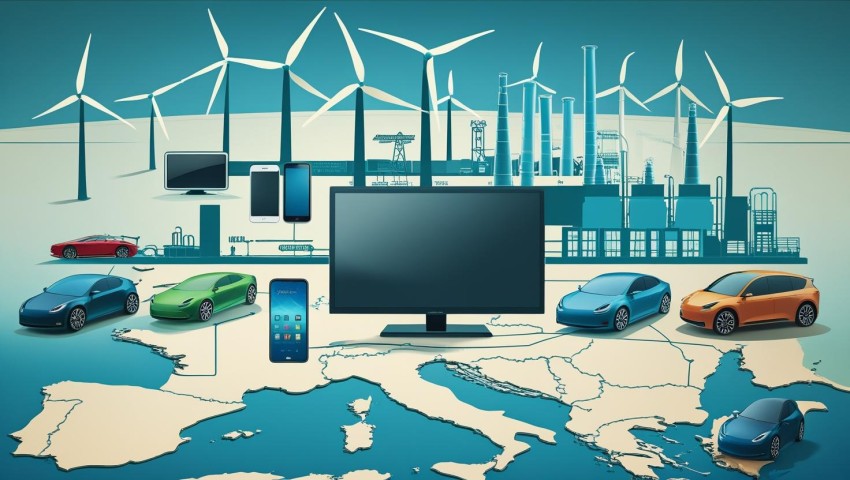
What are rare earth elements?
Rare earth elements (REEs) are a group of 17 chemical elements, including the 15 lanthanides, as well as scandium and yttrium. Despite their name, they are relatively abundant in the Earth’s crust; however, they are rarely found in concentrations high enough to be economically viable.
These elements are known for their unique magnetic, optical and luminescent properties, making them essential for modern industry and the global economy. They are commonly classified into light rare earth elements (LREEs) and heavy rare earth elements (HREEs).
Uses and applications of rare earth elements
Rare earths have distinctive properties that make them indispensable across many industrial and technological sectors:
- Magnetic properties: enable the production of powerful, compact magnets used in electric motors and wind turbines.
- Optical properties: crucial for high-definition displays, electronic devices and advanced lighting technologies.
- Catalytic and chemical properties: key components in industrial processes such as oil refining.
- High thermal and electrical conductivity: ideal for electronic devices and telecommunications systems.
Examples of rare earth applications
- Renewable energy: wind turbine generators rely on neodymium and samarium magnets.
- Technology and electronics: LED and LCD screens use europium and terbium; compact speakers and mobile devices depend on neodymium magnets.
- Aerospace and defence: samarium and gadolinium are used in guided missiles, radar systems and X-ray technologies.
- Automotive and e-mobility: electric cars, bicycles and scooters require rare earths for high-performance electric motors.
Overall, rare earth elements are essential materials for 21st-century technological development.
Current situation and geopolitical context
The main challenge associated with rare earths lies in their extraction and processing, as they do not occur in pure form but are embedded in complex minerals. These processes are costly and technically demanding, and only economically viable in highly concentrated deposits, which are scarce in Spain and Europe.
In addition, the supply chain faces major challenges related to sustainability, recycling and strategic autonomy, areas in which organisations such as ICAMCyL are actively working.
At present, China accounts for approximately 97% of global rare earth production, despite holding around 30% of global reserves. Its dominance is based on large deposits such as Bayan Obo and less restrictive environmental regulations. The United States, once the world’s leading producer through the Mountain Pass mine, has recently restarted production. Other countries, including Australia, Argentina and Japan, are seeking to diversify supply, although none match China’s current scale.
Global demand has grown exponentially: production increased from 75.7 kilotonnes in 1995 to over 350 kilotonnes in 2023, more than quadrupling in three decades.
Rare earths in europe
Europe is investing heavily to reduce its dependence on imports, focusing on electronic waste recycling and the exploration of new deposits. Around two million tonnes of electronic waste are generated annually in Europe, equivalent to more than 16 kg per person, making the recovery of rare earth elements a strategic priority for the European Union.
Rare earths in Castilla y León
In Castilla y León, heavy mineral concentrates have been obtained as a by-product of aggregate extraction in the south-west of the region. These concentrates contained small amounts of monazite, a mineral that hosts all rare earth elements in varying proportions.
During the 1970s and 1980s, the Geological and Mining Institute of Spain conducted monazite prospecting in alluvial sediments in the western part of the region. More recently, in the 21st century, SIEMCALSA carried out rare earth exploration in different geological environments in the provinces of Zamora and Salamanca.
These studies have identified localised indications of rare earth presence, although no economically viable deposits have been discovered to date.
Noticias recientes
-

How will recycled content in batteries be calculated? The JRC lays the groundwork for the future EU methodology
Our day by day / 04-08-2026 -

University of Salamanca presents the progress of the Centre of Excellence for Strategic Mineral Resources to ICAMCyL Foundation
Our day by day / 22-07-2026 -

Spain improves its innovation performance, but business R&D investment remains its biggest challenge
Our day by day / 20-07-2026