The Gran Corta de Fabero: When a Mine Becomes a Forest
Our day by day / 31-03-2026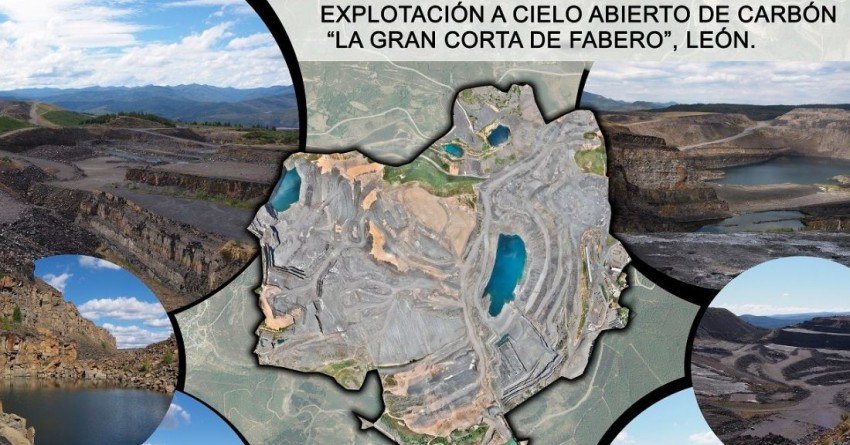
What was the Gran Corta de Fabero?
The Gran Corta de Fabero was for decades one of the largest open-cast coal mining operations in Europe. Located in El Bierzo, in the province of León, its activity began in the late 19th century and did not cease until 2018, when the closure of coal mining in Spain was completed as part of the European Union's climate policies.
During that time, the mine radically transformed a territory of more than 700 hectares, leaving behind a profoundly altered landscape: soil stripped of vegetation, a modified topography and a local community that had built its economic identity around extractive activity.
What happened at the Gran Corta de Fabero over those decades was not an example of responsible mining. And the years that passed before restoration work began were not a model to follow either. Acknowledging this is the starting point for understanding what needs to change in the extractive industry.
But what is happening in that same territory today deserves attention. And it deserves to be told.
The Restoration Project: Scale and Figures
The environmental restoration project at the Gran Corta de Fabero is one of the most ambitious undertaken in Spain in the context of the just transition away from coal mining. Its main figures speak for themselves:
- Total investment: €84 million
- Area under intervention: 772 hectares
- Trees planted: more than 640,000
- Direct jobs created: approximately 200, with priority given to former coal mining workers
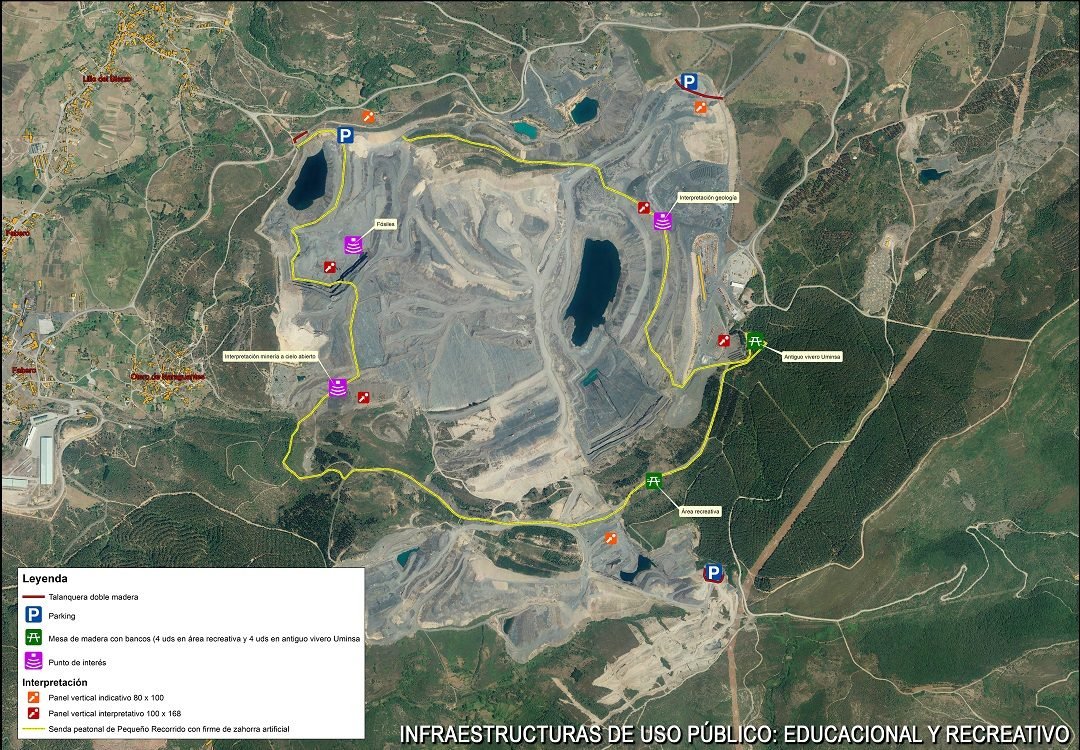
The intervention goes far beyond revegetation. It includes improvements to water infrastructure, the creation of recreational and forestry spaces, and the recovery of historic trails and pathways in the area.
Biodiversity: Beyond Planting Trees
One of the most notable aspects of the project is its focus on native biodiversity. The restoration plan includes:
- 23 native tree species
- 9 native herbaceous and shrub species
- Among them is Prunus lusitanica, known as the Portugal laurel, a species with a very restricted distribution on the Iberian Peninsula and endemic to the surroundings of the area. Its inclusion in the project is not a minor detail: it reflects a commitment to recovering the original ecosystem, not simply providing visual green cover.
The small natural lakes formed by the site's own water dynamics are integrated into the landscape design as elements of ecological and recreational value, rather than being treated as problems to be solved.
An Opportunity for the Local Community
The restoration of the Gran Corta de Fabero is not only an environmental project. It is also a commitment to the economic and social regeneration of a region that lived for generations tied to the coal mining industry.
- The project includes:
- Nature trails and walking routes for recreational and tourism use
- Pastureland for agricultural and livestock use, recovering traditional vocations of the territory
- Recreational areas and viewpoints that make use of the unique topography created by the extraction activity
- Educational infrastructure linked to the area's palaeontological heritage, which features abundant fossil records from the Carboniferous period
This last point opens a particularly interesting opportunity: the development of quality cultural, environmental and palaeontological tourism, which could become a complementary economic driver for El Bierzo.
Science as a Pillar of Restoration
The Gran Corta de Fabero is not only a recovering landscape. It is also a laboratory.
The University of León has developed a research project that uses this site as a pilot area to study innovative methodologies for restoring degraded soils. The work combines the use of organic and inorganic waste materials to promote soil regeneration, contributing to the principles of the circular economy and generating transferable knowledge for other mining territories across Spain and Europe.
What is learned in Fabero can be applied in Asturias, Teruel, Ciudad Real or any other territory facing the challenge of responsibly closing the cycle of a mining operation.
An Uncomfortable but Necessary Lesson
It would be easy to present the restoration of the Gran Corta de Fabero as a success story of responsible mining. But doing so without nuance would be dishonest.
The way that mine was operated for decades was not a model to be followed. And the time that elapsed between closure and the start of restoration works is not an acceptable standard for the future.
The real lesson of Fabero is not that mining always gets it right. It is that when the effort is made to repair, the territory can recover. And that this capacity for recovery makes it all the more necessary to demand that restoration commitments be built into mining projects from day one, not left as an outstanding debt for decades to come.
The mining of the future will be judged by how it treats the land from the very first day, not by what it repairs when it is already too late.
Conclusion: Innovation, Industry and Territorial Responsibility
At ICAMCyL we work at the intersection of innovation, industry and sustainable development in Castilla y León. We believe the raw materials sector can and must be an engine of prosperity for our region, but only if it makes a genuine commitment to the territory, to local communities and to future generations.
Projects like the Gran Corta de Fabero, with all their complexities, are part of that conversation. Because understanding the past is the first step towards building a different model.
Noticias recientes
-

How will recycled content in batteries be calculated? The JRC lays the groundwork for the future EU methodology
Our day by day / 04-08-2026 -

University of Salamanca presents the progress of the Centre of Excellence for Strategic Mineral Resources to ICAMCyL Foundation
Our day by day / 22-07-2026 -

Spain improves its innovation performance, but business R&D investment remains its biggest challenge
Our day by day / 20-07-2026