How will recycled content in batteries be calculated? The JRC lays the groundwork for the future EU methodology
Our day by day / 04-08-2026
The European Commission, through its Joint Research Centre (JRC), has published a technical study that lays the foundations for the future Delegated Act under Article 8 of the EU Batteries Regulation (EU) 2023/1542. This article explains what the regulation requires, its implementation timeline, and why it is particularly relevant for the critical raw materials ecosystem in Castilla y León.
The EU Batteries Regulation requires manufacturers of industrial batteries above 2 kWh, electric vehicle (EV) batteries, SLI batteries (starting, lighting and ignition), and LMT batteries (light means of transport) to declare, for each battery model and manufacturing plant, the percentage of cobalt, lithium and nickel contained in the active materials (and lead in the entire battery) that originates from recycled sources, whether from manufacturing scrap or end-of-life batteries.
This information must be included in the technical documentation accompanying every battery placed on the European market. The objective is to improve traceability, reduce dependence on virgin raw materials, and accelerate the transition towards a truly circular economy in one of Europe's most strategic industrial sectors.
Timeline and minimum recycled content requirements
The obligation to declare recycled content will apply from 18 August 2028, or 24 months after the Delegated Act enters into force, whichever is later. For LMT batteries, the requirement will apply from 2033.
The Regulation also establishes mandatory minimum recycled content targets:
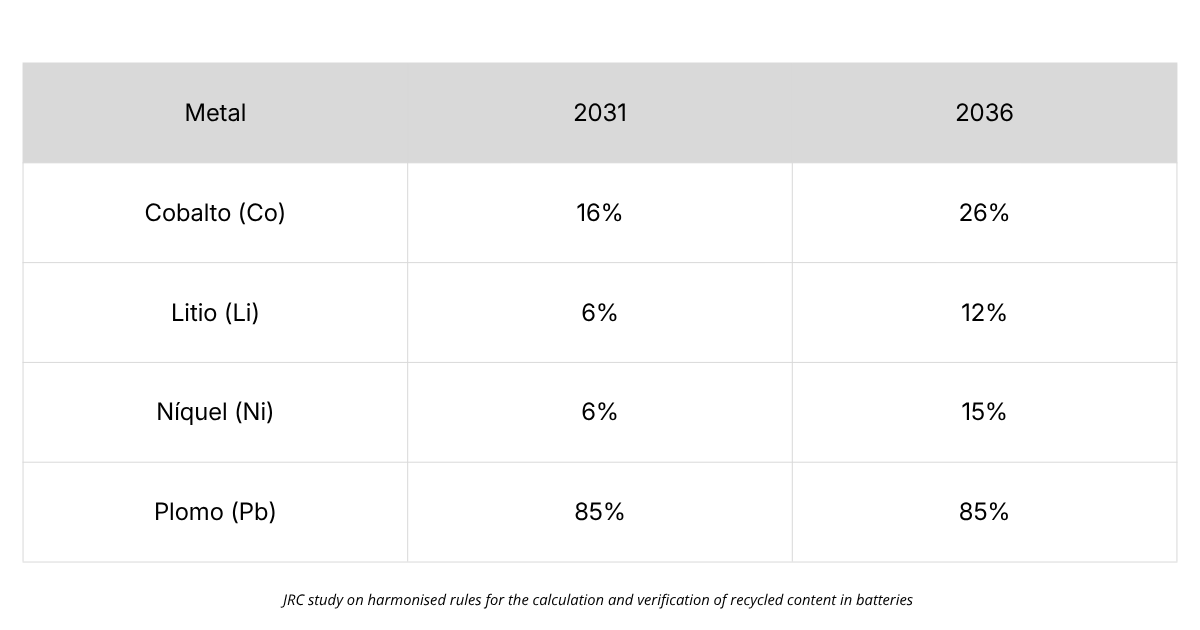
These thresholds may be reviewed in 2029, as foreseen in the Regulation.
What remains to be defined: calculation and verification
The key issue still under discussion—and the focus of the JRC study—is how recycled content should be calculated and verified across complex global supply chains, where extraction, recycling, refining, active material production and battery manufacturing often take place in different facilities and countries.
Based on literature reviews and consultations with industry stakeholders, the JRC analyses several possible traceability approaches:
1. Upstream segregation/controlled blending + mass balance only for battery manufacturers
All actors upstream of the battery manufacturer (recyclers, refiners and active material producers) must apply segregation or controlled blending so that the actual recycled content remains physically traceable until battery production. Only battery manufacturers may use a moving-average mass balance approach at batch or production-line level to allocate recycled content among different battery models or customers.
2. Mass balance for all supply chain actors
This more flexible option allows every actor in the supply chain—not only battery manufacturers—to apply moving-average mass balance with volume reconciliation at batch or production-line level, in addition to segregation or controlled blending.
3. Plant-level mass balance with volume reconciliation and a credit system
This is the option explored most extensively by the JRC following feedback from industry, which considered Options 1 and 2 difficult to implement because they reduce economies of scale. Under this approach, recycled content is calculated at the manufacturing plant level rather than by batch or production line. Credits are then assigned to specific outputs without requiring physical separation of recycled materials. The model includes four variants with different levels of stringency.
The report does not endorse a single preferred methodology. Instead, it concludes that no option is clearly superior and presents two fully developed calculation and verification frameworks that could serve as the basis for the future Delegated Act, expected to be adopted in August 2026.
The complete report is available from the Joint Research Centre (JRC).
Source: Pierri, E., Orefice, M., García-Gutiérrez, P., Bobba, S., Gaudillat, P., Mathieux, F., & Huygens, D. (2026). JRC study on harmonised rules for the calculation and verification of recycled content in batteries (JRC146717 / EUR 40745). European Commission, Joint Research Centre. Publications Office of the European Union.
Noticias recientes
-

How will recycled content in batteries be calculated? The JRC lays the groundwork for the future EU methodology
Our day by day / 04-08-2026 -

University of Salamanca presents the progress of the Centre of Excellence for Strategic Mineral Resources to ICAMCyL Foundation
Our day by day / 22-07-2026 -

Spain improves its innovation performance, but business R&D investment remains its biggest challenge
Our day by day / 20-07-2026